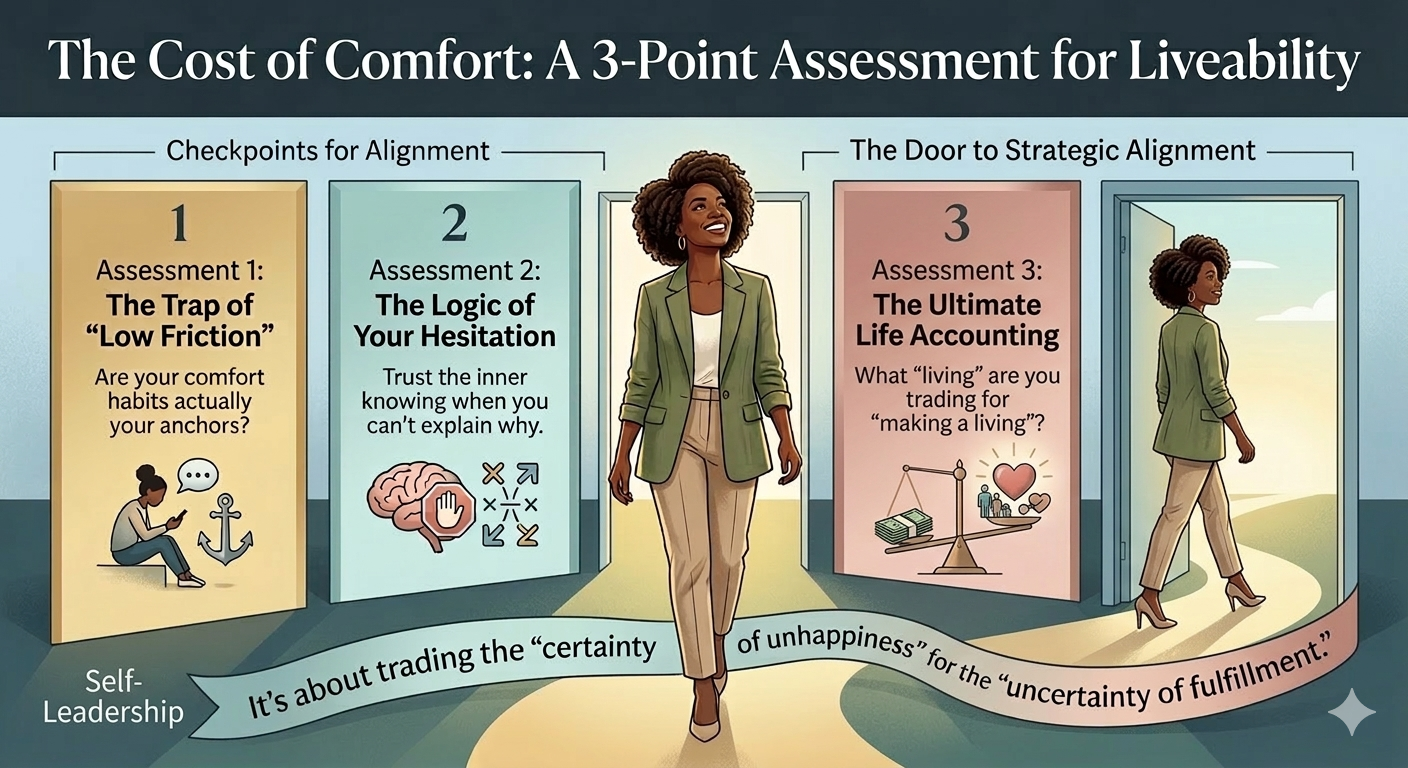
The Cost of Comfort: A 3-Point Assessment
A 3-point assessment to determine hwether you are taking full of advantage of the life you have to live.
We spend a lot of time trying to "build" a good life, a secure career, and stable relationships. But we rarely stop to assess the liveability of what we are building. The noise of expectations, emails, and short-term comforts often drowns out the quiet, important signals from within.
As a result of my decade of experience in coaching I have developed these three, distinct, challenging statements to assess the quality of life. When you stack them up, they aren't merely thought provoking, they create a powerful assessment tool.
If you are feeling stuck, burned out, or just off, use these three assessments to direct you to greater fulfillment.
Assessment 1: The Trap of "Low Friction"
The first assessment comes from a statement that challenges our automatic functioning:
"I challenge you to recognize the things that you do for comfort that are actually keeping you in uncomfortable situations."
As humans, we are wired to seek the path of least resistance. Our brains love "comfortable." Simply because comfortable means predictable. But we often confuse "comfortable" with "good."
Many of our daily comfort-seeking behaviors are actually avoidance coping measures.
• We use doomscrolling to numb the feeling of loneliness.
• We use people-pleasing to avoid the discomfort of conflict, while staying trapped in toxic or one-sided relationships.
• We stay in a dead-end job because the routine is familiar, even as the stagnation is slowly grinding us down.
The cost of this "low friction" lifestyle is incredibly high. By choosing the easy, comfortable path daily, what was meant for protection can inadvertently become a long-term prison.
Assessment 2: The Logic of Your Hesitation
Leaving the comfort trap is often complicated by resistance. You will feel a need to move, but your brain might not have the "why" yet. This is where the second statement applies:
"Sometimes you don't quite know what it is you know but you know you shouldn't proceed. Trust that inner knowing and move accordingly."
This isn’t "woo-woo." This is science. This statement honors intuition, which is the culmination of your brain's sophisticated pattern recognition ability. This process, happening without your conscious awareness, is your built-in self-protection system.
Your subconscious mind can process data and identify red flags far faster than your conscious, analytical mind. If you feel a hesitation, a gut feeling telling you "no", it’s likely your subconscious has clocked the situation and flagged it as a potential issue. Ignoring this "inner knowing" often leads to preventable errors or, worse, self-neglect. You move accordingly by pausing, pivoting, or gathering more data before proceeding.
Assessment 3: The Ultimate Life Accounting
Finally, we arrive at the question of what we are paying for with our life:
"What living are you trading in order to make a living?"
This is the riddle that makes many want to abandon adulthood. It forces a confrontation between survival (the paycheck) and vitality (the life the paycheck is supposed to support), and the juggling act is often exhausting.
Many of us treat our time as a simple commodity to be sold for currency. But time is the only non-renewable resource we have. If the process of "making a living" consumes 100% of your emotional, physical, and creative bandwidth, you may be losing while thinking you're winning.
You may have a great job with greater salary, benefits and unlimited PTO, but you are too stressed by your to-do list, endless meetings, and answering emails, to enjoy the fruits of your labor. Is it worth it? It may be helpful to shift your processing from "how much am I earning?" to "what is this costing me in terms of my life?"
Synthesis: The Path of Alignment
When you look at these three concepts together, they suggest a powerful path forward:
• Acknowledge that your current "comforts" might be the very anchors holding you in a toxic situation.
• Listen to the quiet, powerful hesitation that tells you something needs to change, even before you can explain it logically.
• Renegotiate your life accounting. The goal isn't just to make a living; it’s to make a life.
It’s about trading the "certainty of unhappiness" for the "uncertainty of fulfillment." If you are already living in the former, why not pursue the latter?

Confessions of a Recovering People Pleaser
I'm a recovering people pleaser.
For a long time I gave freely, hoping the care and concern would come back to me.
It rarely did.
So I started to ask myself one question that changed everything.
Read the full confession..
The question I asked myself to spark change.
I’m a recovering people pleaser. I used to say that I wanted to help so many people that it helped me. Someone who was once close to me questioned my logic. It took a while, but I finally realized two things. The first was that I often offered assistance with no regard to my own detriment. Secondly, it was because, more than anything, I hoped that the care and concern would come back to me.
It rarely did.
So, I started to ask myself: what would happen if you put your energy and effort into building a relationship with yourself rather than expending it on people who only receive and rarely give? The answer isn’t fully realized yet, but some things I have noticed. I fight feeling guilty for no longer going above and beyond. I've learned that my boundaries are not for others to honor but for me to enforce. Despite the guilty feelings, I feel less resentment about the imbalance of how I show up vs. others. I can better assess the quality of the relationship.
I would rather be alone than around those performing connection with me. Especially because I am learning to no longer perform with myself to avoid the truth of my experiences or relationships. Sometimes it's lonely. Sometimes I'm sad. It is also an enlightening and wonderful time of self-discovery. Learning to love and accept me for who and how I am at the current moment is the best task that I've ever assigned myself.
If you were to answer the question about where you put your effort and energy, what could change for the better in your life?
If you are ready to be a recovering people pleaser, let's talk.

System Hijack: What Really Drives Disengagement
When people lack clarity, their nervous system shifts into protection mode. Focus, motivation, and follow-through drop long before they realize what’s happening. This is what I call a system hijack, and it affects how we show up in every area of our lives.
When people disengage it isn’t just because they are emotional.
When teams are unproductive, it may not be that they are unmotivated.
Focus evaporates for a reason.
More than we have ever considered, uncertainty is a major factor impacting disengagement, reduced productivity, motivation and most importantly focus. Uncertainty hijacks a person’s nervous system long before it shows up in performance.
Whether it occurs in the personal or professional realm, when people lack clarity about expectations, decisions, shifting priorities, job security, or there is unresolved conflict, the body reacts long before the mind can explain what’s happening.
Here’s what that looks like in real time:
tightening in the chest
difficulty focusing
irritability or withdrawal
worst-case-scenario thinking
overworking or underperforming to compensate
emotional flatness or shutdown
“soldiering through” while quietly bracing for impact
The reality, people will attribute what are physiological responses to personality or skill deficiencies.
In IPS ™ Coaching, this is what we call a system hijack, when there’s more uncertainty, stress or threat than clarity and your nervous system hijacks your ability to function reasonably.
And this is what many underestimate: There’s no amount of breathwork, wellness initiatives, or mindset coaching can override a nervous system that believes it’s unsafe. Clarity is the defining tool.
When someone is under system hijack and they receive:
answers
direction
transparency
acknowledgment
or simply the truth
…the nervous system releases.
Focus returns.
Emotional capacity comes back online.
Engagement rises.
Reason returns.
It is not always the skill level or personality that creates communication or productivity issues. An individual’s environment has a significant impact on their human response.
Here is where the real opportunity lies.
If organizations want healthier teams, stronger culture, and sustainable performance, they must understand the role of uncertainty stress and the responsibility leaders hold in reducing it.
As an individual, learn to recognize when your system is hijacked and what it takes to reset. This is key to getting your focus, clarity, and motivation.
Clarity is never optional.
It is the foundation that every system should stand on.

Internal Programming Meets Workplace Culture
Working together isn’t the same as functioning as a team. Internal programming shapes how people communicate, connect, and show up long before performance metrics ever do.
Workplace culture isn’t merely policies or job descriptions. It’s shaped by how people feel, communicate, and respond under the surface. So many of the challenges teams face are actually human behavior challenges that can lead to performance issues.
Because when people are strained, unclear, or overloaded, teamwork becomes challenging instead of being collaborative.
Working together is not the same as being a team. You cannot get high performance from a team operating in low safety. The emotional climate shows up in the bottom line every single time.
Small teams do not run on tasks and titles. They run on people and the internal programming those people bring with them.
For small teams, communication is not just information exchange. It is the atmosphere people have to breathe all day. It influences whether someone feels grounded or anxious, connected or isolated, energized or exhausted.
When communication becomes inconsistent, people start operating from protection mode instead of presence. They get quiet. They do not ask questions. They make assumptions rather than face backlash. They may be presumed unprofessional when their nervous system is trying to keep them safe.
And here is the truth most workplaces try to gloss over.
When the environment feels unclear or unfair, even the strongest performers start withdrawing to protect themselves. That shift hits morale first, then productivity, and eventually the culture.
If someone dreads coming to work, it is rarely the task list. It is the emotional load they have absorbed from the dynamics around them. That dread is information. It tells you everything about communication patterns, respect for workload, power dynamics, and whether people feel supported or exposed.
IPS Coaching teaches that people show up based on two things.
*How they are programmed internally and how the environment cues them to behave.
Change the cues and you change the culture.
Change the clarity and you change the confidence.
Change the emotional safety and you change the output.
Small teams thrive when clarity is normal, curiosity is welcomed, and people are respected as humans before they are seen as roles. That is what turns a group of individuals into an actual team rather than a collection of people sharing space.
Culture is not the words printed on a wall. Culture is the behaviors you repeat, allow, and ignore.
Do your team’s dynamics reflect people protecting themselves or people working functionally as a team? Working in the same building does not make you a team. Working in alignment does.
If something in this resonates with your workplace experience, pay attention. It is the first sign that the culture is asking for a shift.